
June 6, 2026
Tracing Buddha’s Footsteps Across Odisha’s Diamond Triangle
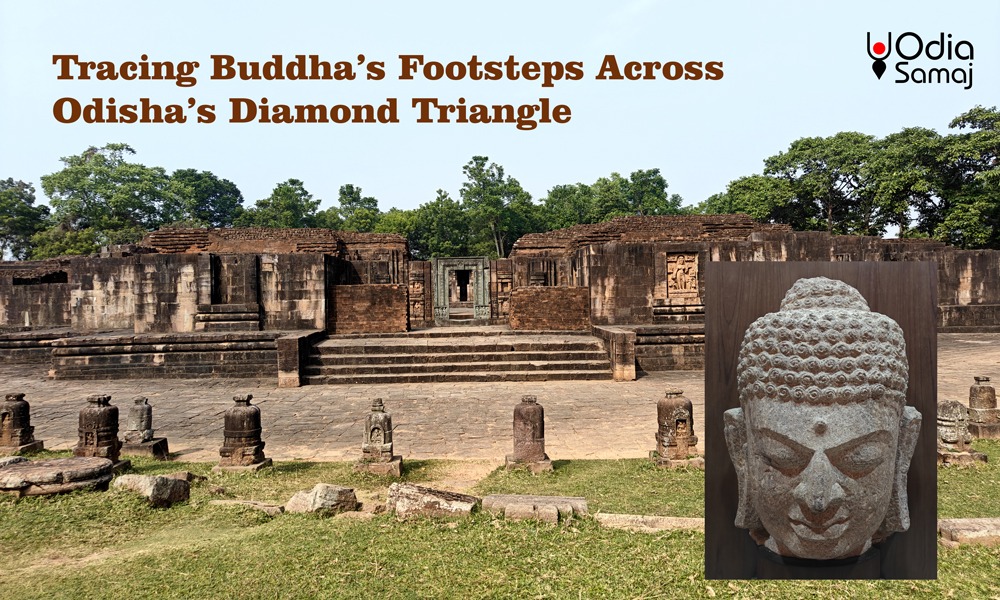
Through Ratnagiri, Udayagiri, and
Lalitgiri- shaped by learning, devotion & silence.
There are landscapes
that change with time.
And then there are landscapes that hold time within them.
The Diamond
Triangle of Odisha is one such rare space. Tucked away from crowded tourist
routes, Ratnagiri, Udayagiri, and Lalitgiri rise gently from the earth,
not as monuments of stone, but as quiet witnesses to centuries of faith,
learning, and human discipline.
These are not ruins
to be glanced at and left behind.
They are places meant to be walked slowly, felt deeply, and remembered
silently.
A
Land Before Silence Took Over
Between the 5th
and 13th centuries, this region of present-day Odisha was alive with
voices. Monks debated philosophy. Students memorised scriptures. Artisans
carved stone with devotion. Pilgrims walked uphill carrying prayers in their
hearts.
This entire zone
formed part of the ancient Pushpagiri Mahavihara, one of the most
important Buddhist learning centres of eastern India. Alongside Nalanda and
Vikramashila, Pushpagiri played a crucial role in shaping Buddhist thought.
The Diamond
Triangle of Odisha was not built overnight. It grew gradually, shaped by
generations who believed that learning, compassion, and restraint were the
highest human virtues.
Ratnagiri:
Where Devotion Became Visible-
Among the three, Ratnagiri
feels the most expressive.
The moment one steps
onto its grounds, there is a sense of careful intention. Monastery ruins are
arranged with precision. Stone pathways guide the visitor naturally, as they
once guided monks in daily routines.
Ratnagiri housed a
large Mahavihara, indicating that it was a central residential and
educational hub. The most striking feature here is the sheer number of votive
stupas, placed by monks and devotees over centuries. Each small stupa
represents an act of faith, a fulfilled vow, or a silent prayer.
The sculptures found
at Ratnagiri reflect a softer, more compassionate visual language. Faces are
calm. Eyes are gentle. Postures suggest balance rather than dominance. This
tells us something important. Buddhism here was not austere or withdrawn. It
was warm, thoughtful, and deeply humane.
Ratnagiri shows how
faith can be both disciplined and tender.
Udayagiri:
Where Knowledge Had Structure-
If Ratnagiri touches
the heart, Udayagiri speaks to the mind.
As the largest site
of the Diamond Triangle of Odisha, Udayagiri reveals how organised
Buddhist life once was. A massive central stupa anchors the site, surrounded by
monastery complexes designed for daily living.
The presence of a step
well is particularly significant. It shows that monks planned for
sustainability, water access, and long-term settlement. This was not a
temporary retreat. It was a functioning academic and spiritual township.
Here, monks followed
schedules, responsibilities, and collective discipline. Learning was not
abstract. It was lived, practiced, and shared. Knowledge flowed through
conversation, ritual, and repetition.
Udayagiri reflects
Buddhism as a system that valued clarity, order, and community living.
Lalitgiri:
Where Faith First Took Root-
Lalitgiri feels older than the others, not just
in history, but in emotion.
Perched quietly on a
hilltop, Lalitgiri carries a sense of origin. Archaeological discoveries here
revealed a relic casket placed inside the main stupa, believed to
contain sacred remains associated with the Buddha. This established Lalitgiri
as one of the earliest Buddhist centres in Odisha.
Unlike Ratnagiri or
Udayagiri, Lalitgiri is simpler. There is less ornamentation, fewer structures,
and more open space. But that simplicity carries weight.
It feels like the
beginning of belief.
When faith was personal.
When devotion needed no display.
Lalitgiri reminds us
that spiritual movements often start quietly, long before they take
architectural form.
The
Flow of Buddhist Thought
What makes the Diamond
Triangle of Odisha exceptional is the presence of both Mahayana and
Vajrayana traditions.
Early practices
focused on monastic discipline and philosophical study. Over time, Vajrayana
elements introduced ritual symbolism, esoteric practices, and complex
iconography. This evolution is visible in sculptures, motifs, and spatial
planning across the three sites.
Rather than replacing
earlier beliefs, new ideas layered themselves gently over time. This reflects
Odisha’s cultural nature. Absorbing, adapting, and harmonising rather than
erasing.
Life
Beyond Stone
It is easy to admire
the architecture, but the true essence of the Diamond Triangle of Odisha
lies in the lives once lived here.
Imagine monks waking
before sunrise. Chanting softly as mist covered the hills. Students sitting in
open courtyards, repeating verses under guidance. Artisans carving stone not
for fame, but for merit. Travellers resting, learning, and moving onward with
new understanding.
These hills once
shaped minds, not empires.
Why
the Diamond Triangle of Odisha Matters Today!
In a world that moves
fast, the Diamond Triangle of Odisha offers a different rhythm.
It teaches patience.
It teaches listening.
It teaches that wisdom does not shout.
These sites remind us
that Odisha has always been a land of layered identity. A place where tribal
belief, Buddhist philosophy, and later Hindu traditions flowed into each other
naturally.
Preserving these
hills is not just about archaeology. It is about protecting a mindset that
valued reflection over reaction.
Visiting
with Respect-
The Diamond
Triangle of Odisha is best experienced slowly. A single day is enough to
visit all three sites, but not enough to absorb them fully.
The cooler months
between November and February allow the hills to open themselves gently.
Walking paths, museum spaces, and open ruins should be approached with patience
and respect.
This is not a place
for noise.
It is a place for noticing.
A
Closing Reflection
The Diamond
Triangle of Odisha does not offer spectacle.
It offers stillness.
Three hills continue
to stand, carrying the weight of centuries without complaint. They do not ask
to be remembered loudly. They ask only to be understood.
Some histories are
written in books.
Others are written in silence.
Here, silence speaks.
Recent Post

ଅଧ୍ୟୟନ ପରିପ୍ରେକ୍ଷୀରେ ବଣ୍ଡା ସମ୍ପ୍ରଦାୟ
ସୁନ୍ଦରଗଡ଼ର ଖଣ୍ଡାଧାର , ଘୋଡ଼ା ଲାଞ୍ଜ ପରି ଦିଶୁଥିବା ଝରଣା!
May 22, 2026

ଓଡ଼ିଶା ଜନଜାତି ସଂସ୍କୃତି ଓ ବିଶ୍ୱାସର ନିଆରା ପରମ୍ପରା
May 11, 2026