
August 8, 2026
Niladri Bije and Odisha’s Sweetest Lesson in Love
At
the end of Rath Yatra, a closed temple door, an aggrieved Goddess and a bowl of
syrupy sweets turn devotion into a deeply human story of dignity, apology and
homecoming.
Some
festivals leave us awestruck by their scale. Others draw us closer through
their quiet emotions.
Niladri
Bije does both.
It
arrives after the thunderous chants, the magnificent chariots, the ocean of
devotees and the divine journey through the streets of Puri. Yet, the final
chapter of Rath Yatra is not about grandeur. It unfolds at a closed door.
Lord
Jagannath has returned home, but Goddess Lakshmi is not ready to welcome him
inside.
What
follows is one of the most endearing moments in Jagannath culture. The Lord of
the Universe must make peace with the Goddess he left behind. His offering is
not gold, jewels or a display of divine power.
It
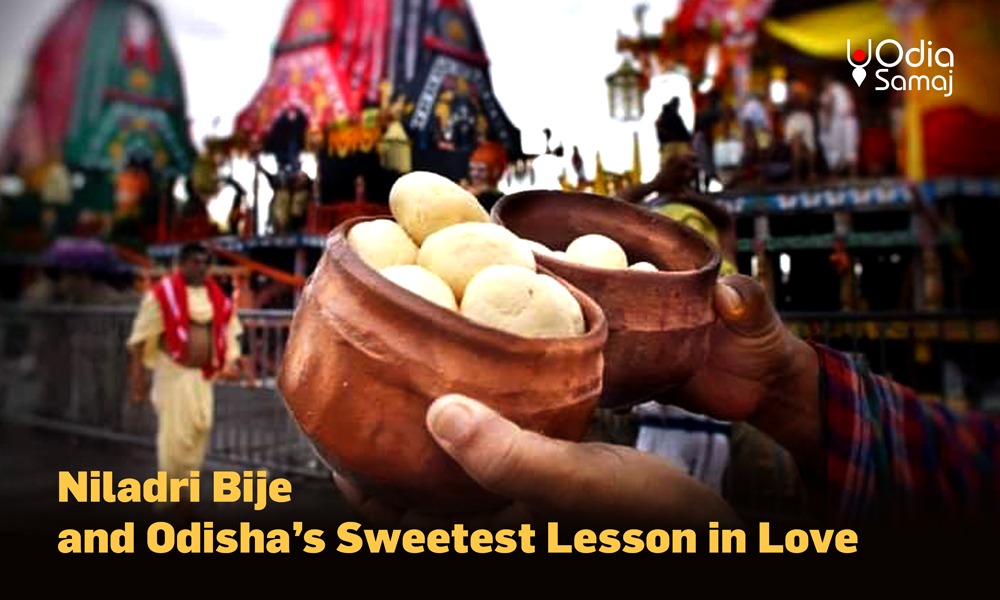
is a bowl of soft, syrup-soaked rasagolas.
And
with that simple gesture, an ancient ritual becomes a timeless story about
relationships, remembrance and the sweetness of saying, “You matter to me.”
The Journey Ends at a Closed Door
Niladri
Bije is the concluding ritual of the annual Rath Yatra. After their journey to
the Gundicha Temple and the return known as Bahuda Yatra, Lord Jagannath, Lord
Balabhadra and Devi Subhadra are ceremonially taken back into the Shree
Jagannath Temple and restored to the sacred Ratna Singhasana.
But
Lord Jagannath’s return is not as effortless as one might expect.
Goddess
Lakshmi remembers that when the Lord began his grand journey, he took his
brother Balabhadra and sister Subhadra with him. She, however, was left behind.
Her
displeasure has already been expressed during Hera Panchami, when she visits
the Gundicha Temple in search of him. On Niladri Bije, as Jagannath finally
approaches the temple, she closes the Jai Vijay Dwar and prevents him from
entering.
For
a few playful moments, the ruler of the universe finds himself standing outside
his own home.
The Goddess Who Refuses to Be Forgotten
It
is easy to describe Goddess Lakshmi as angry, but her emotion carries a deeper
meaning.
Her
closed door is not merely an act of annoyance. It is a reminder that affection
cannot be taken for granted. Even the closest relationships need attention,
acknowledgement and respect.
Through
Lakshmi, the tradition gives dignity to hurt.
She
does not quietly suppress her disappointment. She makes herself heard. She
refuses to behave as though nothing has happened simply because Jagannath has
returned.
Her
response feels remarkably human.
Who
has not felt overlooked by someone they love? Who has not waited for an
apology, an explanation or even a small gesture that says, “I remembered you”?
In
Niladri Bije, the Goddess is not expected to forget her pain simply because the
celebration is over. The Lord must recognise it first.
When Even the Divine Must Make Peace
The
most beautiful part of the ritual is not that Jagannath eventually enters the
temple.
It is how he enters.
He
does not command the doors to open. He does not use his authority to dismiss
Lakshmi’s displeasure. Instead, a lively ritual exchange takes place at the
entrance. Words, humour, affection and gentle persuasion become part of the
reconciliation.
Then
comes the offering of rasagola.
At
that moment, Jagannath is not presented only as a distant and all-powerful
deity. He becomes a loving husband attempting to win back the affection of his
wife.
This
is one of the many reasons Jagannath culture feels so intimate.
Mahaprabhu
does not remain confined to unreachable ideas of divinity. He travels among the
people, falls ill, rests, changes his appearance, enjoys food, shares
relationships and experiences emotions that devotees instantly understand.
In
Niladri Bije, he also teaches that greatness does not place anyone above
apology.
Sometimes,
the most powerful thing one can do is acknowledge another person’s hurt and
take the first step towards healing it.
Rasagola Becomes a Language
Why
rasagola?
Because food has always spoken a language that words alone cannot express.
Across
Odia homes, affection is often served rather than announced. A favourite dish
prepared after a disagreement, an extra helping placed quietly on a plate or a
sweet brought home after a long journey can say what pride may prevent the
voice from saying.
During
Niladri Bije, rasagola becomes that unspoken language.
It
is more than a dessert and more than a ceremonial offering. Its softness
replaces stubbornness. Its sweetness follows bitterness. Its roundness seems to
hold within it the promise that relationships, too, can return to completeness.
The
sweet does not erase what happened. It acknowledges it.
That is what makes the gesture meaningful.
A Homecoming Completed by Forgiveness
Once
the offering is accepted, Lakshmi’s anger softens.
The doors open.
Lord
Jagannath enters the temple and returns to the Ratna Singhasana. The long
journey of Rath Yatra finally reaches its true conclusion.
The
chariots may have returned earlier. The roads may have fallen silent. The grand
public ceremonies may be nearly over. Yet the Lord’s homecoming remains
incomplete until harmony has been restored inside the temple.
This
is perhaps the most touching truth contained within Niladri Bije.
A
journey does not end merely when we arrive at a familiar place. It ends when
those waiting for us feel remembered.
A
house becomes a home only when love is restored within it.
From Temple Tradition to Rasagola Dibasa
Over
time, the sacred offering has grown into a celebration shared by Odias
everywhere.
Niladri
Bije is now observed across Odisha as Rasagola Dibasa. Families exchange
sweets, shops prepare fresh batches of rasagola, cultural organisations share
the story of the ritual, and Odias living far from the state celebrate their
connection with Jagannath culture. The public observance of Rasagola Dibasa
began in 2015 and has since become a joyful expression of Odisha’s culinary and
cultural identity.
Yet
the pride surrounding the day need not be limited to debates about where the
sweet originated.
Its
deeper glory lies in the meaning Odisha has given it.
Here,
rasagola is not simply something to taste. It participates in a sacred
conversation. It stands at the temple door as a symbol of humility, affection
and reunion.
Its
history is preserved not only in recipes or written records, but also in a
living ritual performed year after year.
Odisha’s Sweetest Lesson
Niladri
Bije reminds us that love is not the absence of disagreement.
Love is the willingness to return after disagreement.
It
is the courage to listen when someone feels forgotten. It is the humility to
make amends even when one possesses power. It is the grace to open the door
when sincerity finally arrives.
Goddess
Lakshmi teaches us that our feelings deserve acknowledgement.
Lord Jagannath teaches us that an apology does not diminish greatness.
Rasagola
teaches us that even a small gesture can carry an enormous emotion when it is
offered with love.
Perhaps
that is why Niladri Bije brings such warmth to the heart. Its characters may be
divine, but its emotions belong to every home.
The
Rath Yatra begins with the Lord leaving his temple to come closer to his
devotees.
Niladri Bije ends with the Lord showing all of us how to return home.
Not
merely with celebration.
Not merely with pride.
But with sweetness in our hands, humility in our hearts and love waiting on the
other side of the door.
Recent Post
The Neelkanth: Odisha's Blue Treasure of Nature
ଓଡ଼ିଆ ସାମ୍ବାଦିକତାର ଦୀପସ୍ତମ୍ଭ ଉତ୍କଳ ଦୀପିକା
August 5, 2026
Niladri Bije and Odisha’s Sweetest Lesson in Love
July 25, 2026

ଭକ୍ତି, ଐତିହ୍ୟ ଓ ପରମ୍ପରାର ରଥଯାତ୍ରା
July 21, 2026

ପୁରାତନ ପରମ୍ପରାରୁ ପ୍ରେରଣା ସାଜିଛି 'ତୁମ୍ବା'
July 8, 2026